Wellington’s coastal properties offer spectacular views and an enviable lifestyle, but they also demand a landscape design approach that few other New Zealand regions require. Salt-laden winds, steep terrain, and sandy soils create an environment where ordinary garden plants struggle and standard materials corrode within seasons.
This guide covers everything you need to know about creating resilient, beautiful outdoor spaces along Wellington’s coast—from the hardy plants that thrive in Cook Strait conditions to the construction methods that ensure your investment lasts for decades.
- Key Takeaways
- Understanding Wellington’s Coastal Conditions
- Designing for Coastal Wellington: Form, Shelter, and Views
- Hardscaping and Materials That Survive the Coast
- The Coastal Plant Palette for Wellington and Kāpiti
- Creating Liveable Outdoor Spaces on Exposed Sites
- Dealing with Wind, Water, and Erosion
- The Coastal Design–Build–Aftercare Process in Wellington
- Costs, Timing, and Planning Your Coastal Project
- Frequently Asked Questions – Coastal Landscaping Wellington NZ
- How close to the sea can I plant, and will anything actually survive right on the beachfront?
- Do I need council consent for coastal landscaping in Wellington or Kāpiti?
- What maintenance do coastal gardens in Wellington typically require?
- Can I grow fruit trees and edibles in a coastal Wellington garden?
- How long does it take for a coastal garden to “fill out” and feel established?
- What is the biggest challenge for coastal landscaping in Wellington?
- When is the best time to plant in Wellington's coastal areas?
- How can I efficiently water plants in a coastal garden with dry spells?
- How can local rocks be used in coastal landscaping?
- What plant characteristics help them survive Wellington's coastal conditions?
- How should I arrange plants for effective shelter and erosion control?
- Are there plants that tolerate both water inundation and drought?
- Which native New Zealand plants are best suited to Wellington’s coast?
- What is divaricating growth and why is it important?
- What materials withstand Wellington’s coastal environment for landscaping?
- How should mulch be applied in coastal gardens?
- How can soil quality be improved on sandy coastal sites?
- What types of decorative stones are suitable for coastal landscaping?
- How can crushed shell benefit my garden?
- What landscaping services are available in Wellington?
- Can professional landscaping increase my property value?
- Are sustainable landscaping practices common in Wellington?
- Conclusion
Key Takeaways
Wellington’s coastal gardens must contend with salt spray, powerful winds, rocky or sandy soils, and often steep sites. When done well, coastal landscaping delivers durability, natural shelter, low maintenance requirements, and year-round visual appeal that actually improves with age.
- Location-specific focus: This article addresses Wellington and nearby coastal areas including the Kapiti Coast, Wainuiomata Coast, Eastbourne, and the Hutt Valley—not generic New Zealand conditions.
- Wind-resistant plant palettes: Learn which native plants and ornamental species cope with Cook Strait exposure and how to arrange them for maximum shelter.
- Hardscaping and drainage solutions: Discover materials and construction techniques suited to exposed, salty, seismically active sites.
- View preservation meets shelter: Design strategies that protect stunning views while creating usable, wind-protected garden rooms.
- Process clarity: Understand the typical design, build, and aftercare sequence for coastal projects in the Wellington region.
- Practical FAQ: Find answers to common questions about consents, costs, timing, and ongoing maintenance at the end of this page.
Understanding Wellington’s Coastal Conditions
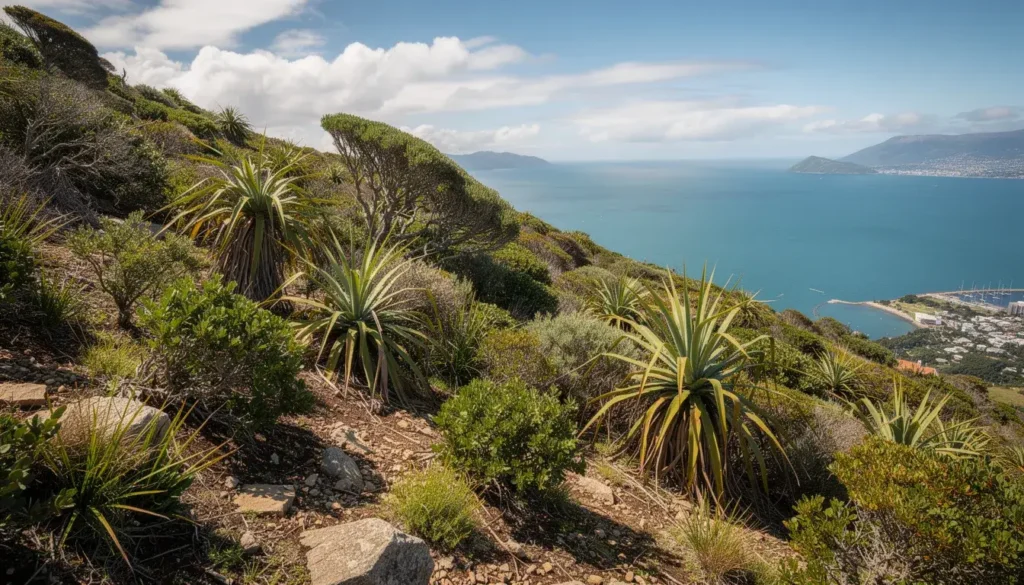
Wellington’s coastline stretches from the rugged Kāpiti Coast in the north through to the rocky headlands of the Miramar Peninsula and beyond to the sheltered bays of Eastbourne. This diverse coast includes sandy beaches like Lyall Bay, urban waterfronts like Oriental Bay, exposed dune systems at Raumati and Waikanae Beach, and dramatic cliff-top sites in Seatoun and Pukerua Bay.
The environment here is defined by extremes. Cook Strait funnels some of New Zealand’s strongest winds directly into the Wellington region, with prevailing northerlies and southerlies regularly exceeding 100 km/h during storms. Salt spray from crashing waves travels significant distances inland, coating plants and materials in a corrosive film. High UV exposure during summer, occasional drought conditions, and then heavy winter rain create a challenging mix that demands thoughtful plant selection and robust construction.
These conditions affect every aspect of coastal landscaping:
- Cliff-top properties in Khandallah, Ngaio, and Seatoun face maximum wind exposure and require engineered retaining walls and deep-rooted shelter planting
- Narrow coastal sections in Island Bay and Petone demand space-efficient design that maximises shelter without sacrificing usable ground
- Dune-side properties in Raumati, Waikanae Beach, and along the Kapiti Coast contend with sandy soils that drain rapidly and hold few nutrients
- Harbour-facing sites in Oriental Bay, Hataitai, and Maupuia balance stunning views with direct exposure to salt-laden winds
Understanding these site-specific challenges is the first step toward creating a garden that will thrive rather than merely survive.
Designing for Coastal Wellington: Form, Shelter, and Views
The fundamental tension in coastal landscape design is the balance between preserving those extraordinary views of Wellington Harbour or Kāpiti Island and creating sheltered, usable outdoor rooms. Get this balance wrong, and you end up with either a wind-blasted space nobody uses or a fortress that blocks the very views you bought the property for.
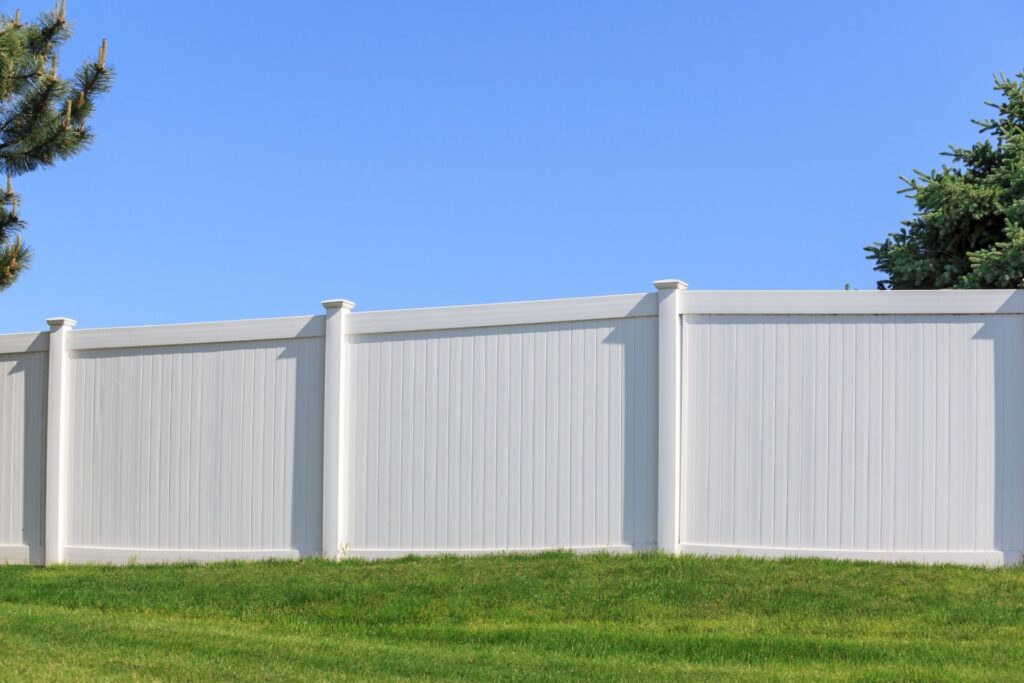
Effective coastal design relies on several key principles. Low, layered planting works far better than tall hedges or solid walls—it filters wind rather than creating turbulence, and it frames views rather than blocking them. Wind screens made from slatted timber or tensioned cables slow airflow without acting as barriers. Orienting decks, patios, and seating areas away from dominant winds makes the difference between a space that gets used year-round and one that sits empty for months.
Consider common Wellington scenarios. A windy Miramar backyard might be transformed by repositioning the main deck to the northern side of the house, where the building itself provides shelter from southerlies. A Petone beachfront villa could gain a sheltered courtyard through strategic placement of raised planter boxes filled with salt-tolerant shrubs, creating an intimate space that captures afternoon sun.
The most successful coastal designs achieve these goals:
- Year-round usability through shelter that works in all seasons
- Privacy without losing light using semi-transparent screens and layered planting
- Storm resilience with materials and structures rated for Wellington’s wind loads
- Easy access around sloping sites via well-designed steps, paths, and terracing
When these elements come together, the result is an outdoor space that feels like a natural extension of your home—protected enough to enjoy, yet open enough to embrace the coastal environment.
Hardscaping and Materials That Survive the Coast
Material selection is perhaps the most critical decision in Wellington coastal landscaping. The combination of salt air, high winds, heavy rain, and intense UV breaks down ordinary materials within a few seasons. Choosing the right materials from the start saves thousands in replacement costs and ensures your garden looks as good in ten years as it does on completion.
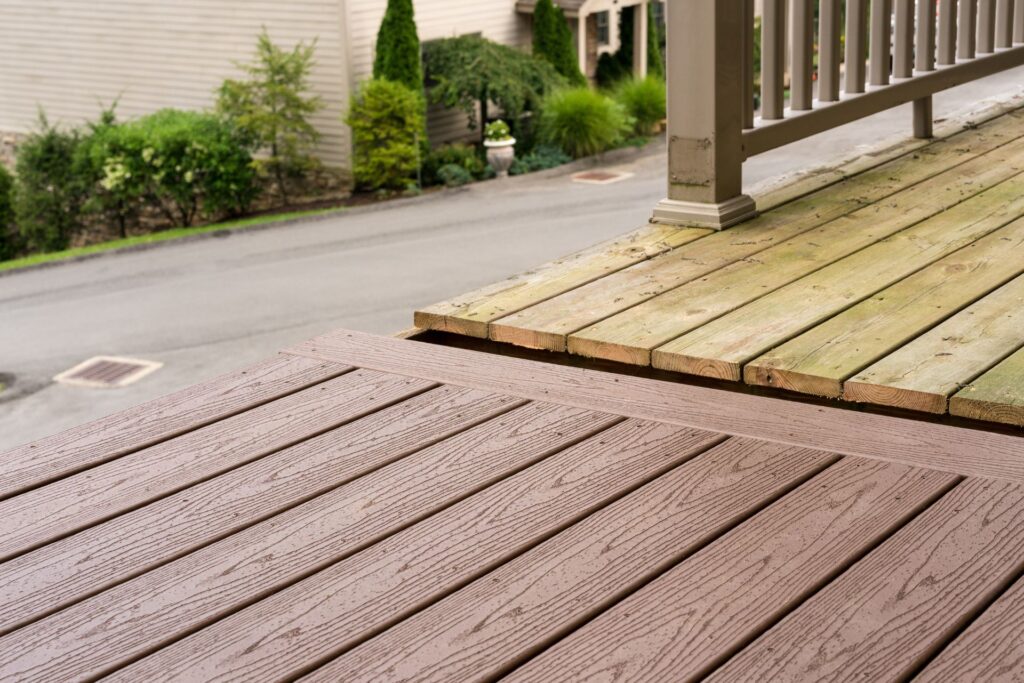
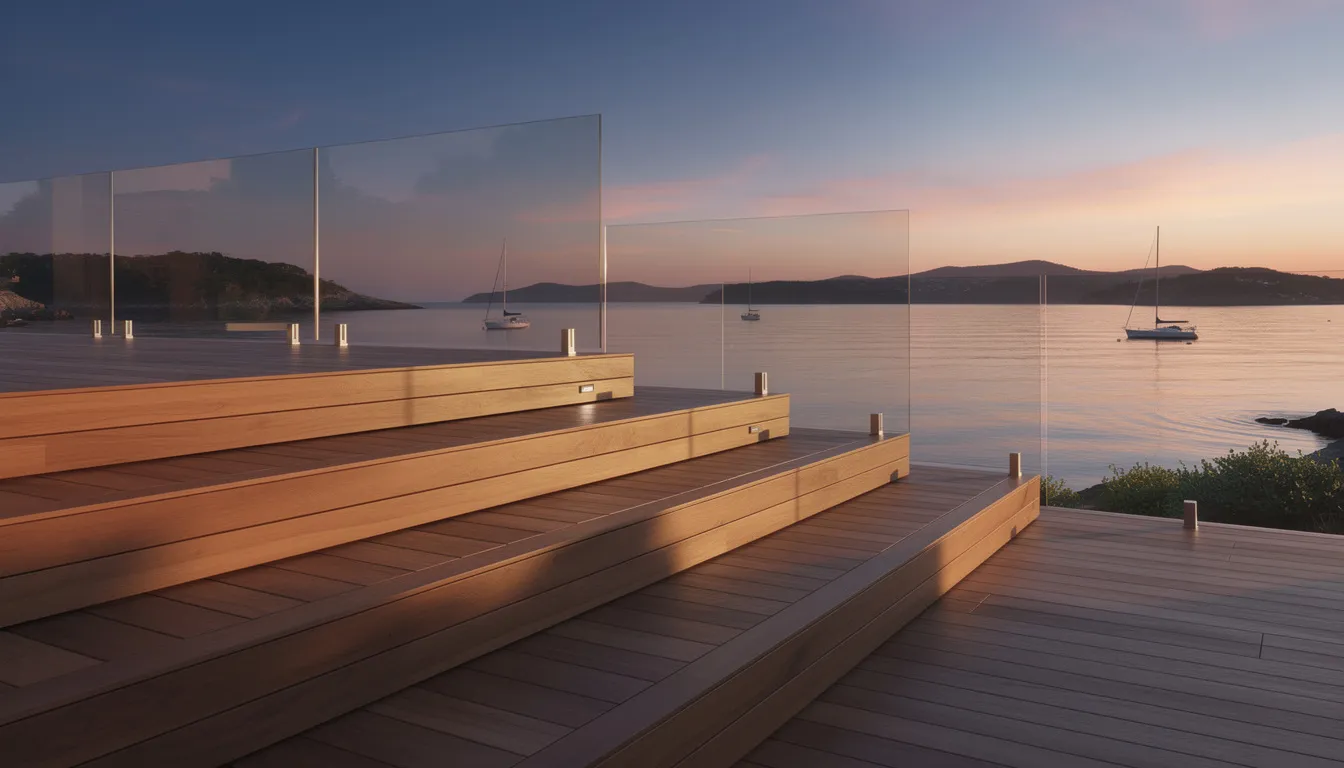
Decking takes the brunt of coastal conditions. Hardwoods like kwila and vitex offer natural durability and resistance to rot, though they require periodic oiling to maintain their appearance. Composite boards have become increasingly popular for their low maintenance and consistent performance in wet conditions—an important consideration for exposed decks in Maupuia and Hataitai where surfaces stay damp for extended periods. Whatever material you choose, slip resistance is essential on wet, exposed sites.
Fixtures and fasteners require special attention near the coast. Standard galvanised steel corrodes rapidly in salt air. Stainless steel 316 marine-grade fittings are the minimum standard for pergolas, balustrades, and any metalwork within the salt zone. Hot-dip galvanised steel with additional powder coating provides a more affordable alternative for elements further from direct exposure.
Surface materials for paths, patios, and driveways must handle both drainage and durability. Popular choices for coastal Wellington gardens include:
- Exposed aggregate concrete for durability and texture
- Locally sourced river stones and aggregates for natural appearance
- Crushed shell toppings that complement coastal surroundings
- Quality concrete pavers suited to Paraparaumu and Waikanae coastal gardens
- Permeable paving options that manage stormwater on steep sites
Retaining walls are often essential on Wellington’s steep coastal sites. In areas like Paekākāriki, Brooklyn, and Ngaio, terracing transforms unusable slopes into functional garden spaces. However, Wellington’s seismic requirements mean that significant retaining structures need engineering sign-off. The upfront investment in proper engineering pays dividends in long-term stability and compliance.
A coastal-proof materials checklist should include: marine-grade stainless steel for all fixings, UV-stabilised fabrics and cables, rot-resistant or composite timbers, and locally appropriate aggregates that complement the natural coastal environment.
The Coastal Plant Palette for Wellington and Kāpiti
Plant selection for Wellington’s coast requires a fundamentally different approach than inland gardening. The right plant in the right place will thrive with minimal intervention, while the wrong choice will struggle despite your best efforts. Salt tolerance, wind hardiness, and often drought resilience form the essential selection criteria.
Native species have evolved over millennia to handle exactly these conditions, making them the backbone of any coastal planting scheme. For first-line shelter belts facing the most extreme exposure, the proven performers include:
Core shelter plants:
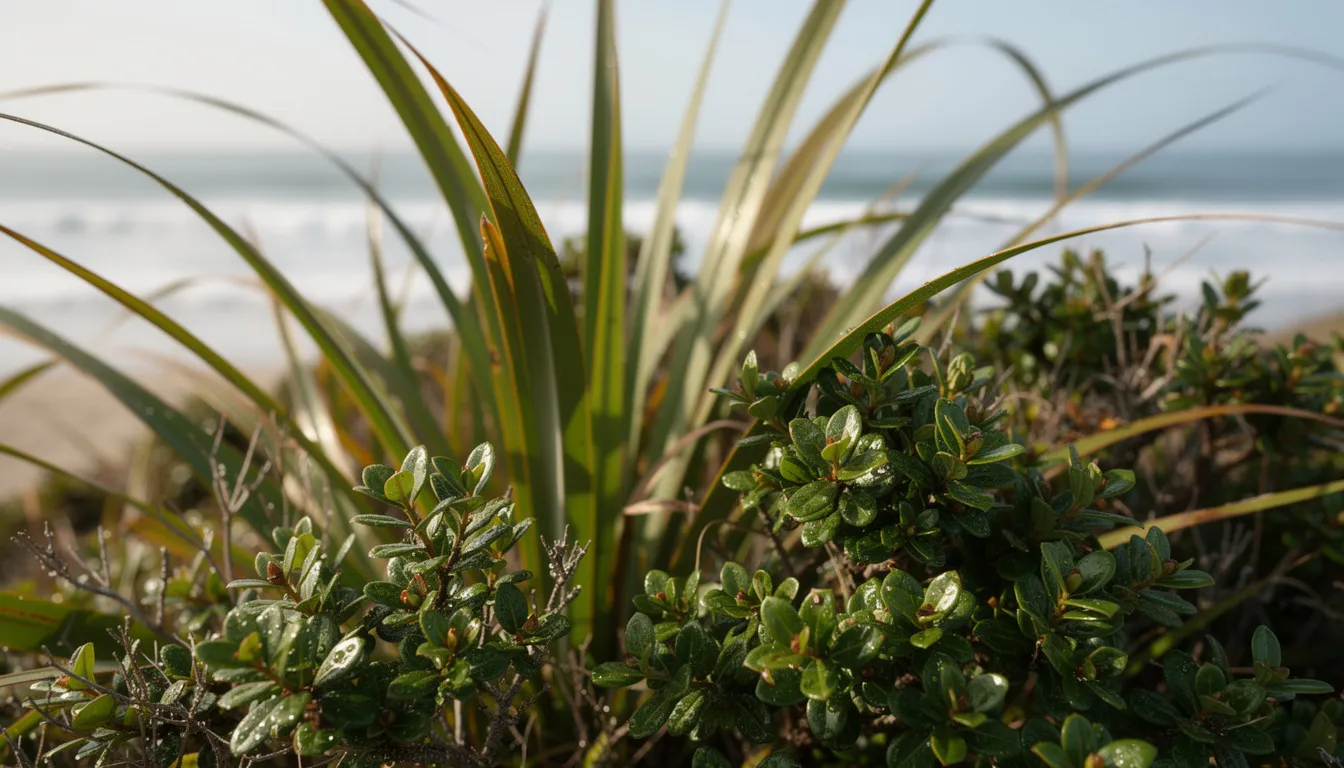
- Taupata (Coprosma repens) – dense, glossy foliage that shrugs off salt spray
- Karo (Pittosporum crassifolium) – fast-growing with silvery-backed leaves
- Ngaio (Myoporum laetum) – tough coastal tree that establishes quickly
- Flax (Phormium tenax) – architectural form with deep roots for bank stabilisation
Once shelter is established, a wider range of species becomes viable. For structure and form in the middle layer, consider hardy plants like hebes, corokias, and olearia—shrubs that bring texture and seasonal colours while requiring minimal maintenance.
Ornamental coastal performers:
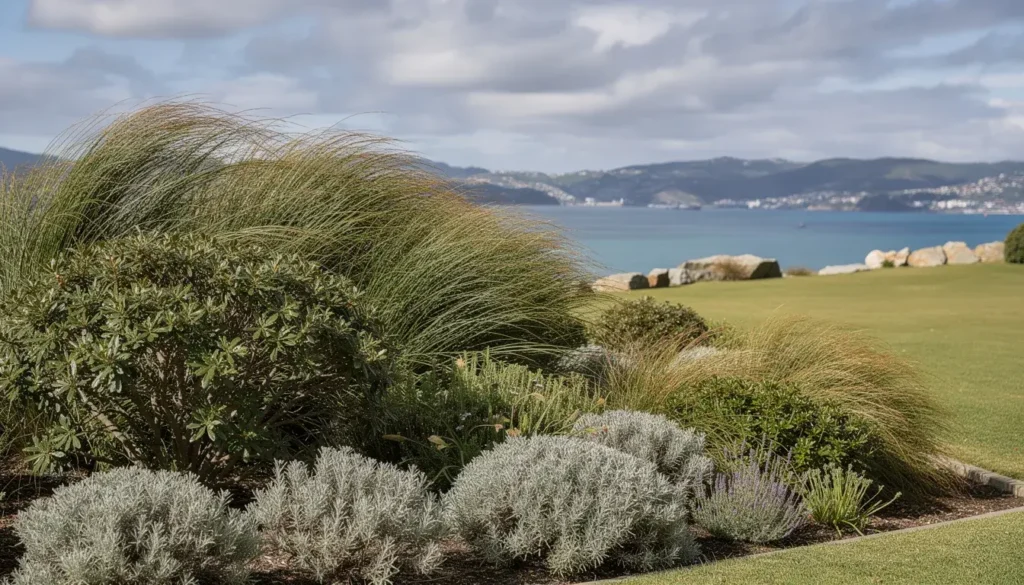
- Lomandra varieties for grassy texture and drought tolerance
- Westringia for soft grey-green foliage year-round
- Libertia for striking sword-like leaves and white flowers
- Ornamental grasses that move beautifully in wind
Planting strategy matters as much as species selection. Graded shelter belts—tallest plants at the back, stepping down toward the sea—filter wind progressively rather than creating a single barrier. Groundcovers stabilise dunes and banks while suppressing weeds. Planting in groups rather than as isolated specimens reduces wind stress on individual plants and creates a more naturalistic form.
For specific Wellington sites, the approach varies. Sandy Kapiti Coast soils require drought-tolerant species and generous soil improvement with organic matter before planting. Exposed ridgelines in Brooklyn and Karori benefit from wind-filtering mixes of mixed-height shrubs rather than single-species hedges. Steep sites in Seatoun and Eastbourne need plants with deep root systems that contribute to slope stability.
Creating Liveable Outdoor Spaces on Exposed Sites
The ultimate goal of coastal landscaping is transforming under-used, wind-battered sections into outdoor rooms that extend your living space. This means creating areas for dining, lounging, and entertaining that work from early morning coffee through to evening drinks—regardless of Wellington’s changeable weather.
Orientation is everything. A deck positioned to capture afternoon sun while the house blocks prevailing southerlies becomes usable for eight months of the year rather than two. In Island Bay or Titahi Bay, this might mean wrapping a deck around the northern side of the house. In Oriental Bay, it could involve creating a sunken courtyard that catches western light while remaining sheltered from the harbour breeze.
Structural elements create the shelter that makes these spaces functional:
- Pergolas with adjustable louvres control sun and rain while maintaining openness
- Glass screens block wind without interrupting views
- Slatted timber screens filter wind while adding privacy and visual warmth
- Living walls of carefully selected shrubs provide natural wind protection that improves over time
Built-in features add functionality and reduce maintenance. Seating integrated into retaining walls eliminates the need for outdoor furniture that blows around in storms. Outdoor fireplaces or fire pits extend the usable season well into autumn and early spring—particularly valuable in Wellington’s climate. Integrated outdoor kitchens eliminate the trip back inside and make entertaining effortless.
The combination of thoughtful orientation, robust shelter, and practical features transforms even the most exposed Wellington sites into spaces where life happens. A family in Whitby gains a wind-protected play area that children actually use. An Oriental Bay apartment gets a balcony garden with planter boxes creating an intimate dining nook. A Lyall Bay bach becomes the gathering place for summer barbecues and winter fire-pit evenings.
Dealing with Wind, Water, and Erosion
Wellington’s combination of strong winds, intense downpours, and coastal erosion demands engineering solutions as much as horticultural ones. Ignoring these forces results in sodden lawns, slipping banks, and plantings that never establish. Addressing them thoughtfully creates landscapes that actually improve with age.
Wind management requires subtlety. Solid walls and fences might seem like the obvious solution, but they create turbulence on the leeward side that can be worse than the original wind. Effective wind shelter uses layered planting, slatted fences, and pergolas to progressively slow airflow. For extremely exposed sites, an experienced team might install temporary wind cloth baffles at 1.5-metre intervals, maintaining clear communication with homeowners about the two to three-year timeline before plantings provide natural shelter.
Drainage solutions prevent the puddling and waterlogging that kills plants and undermines structures. On coastal and hill sites, this typically means:
- Sub-surface drainage behind all retaining walls
- Permeable paving that allows stormwater infiltration
- Rain gardens that capture runoff and filter it naturally
- Swales that direct water away from structures and towards appropriate discharge points
Erosion control is particularly critical on sandy and sloping sites. Dune stabilisation along the Kapiti Coast uses native grasses like spinifex and pingao, along with groundcovers that knit together to hold soil in place. Banks in Lower Hutt coastal suburbs need deep-rooted plants and sometimes geotextile fabrics to prevent slippage during heavy rain.
Site problems to address in coastal design:
- Puddling and soggy lawns → install sub-surface drainage and raise planting areas
- Slipping banks → stabilise with deep-rooted natives and engineering where required
- Wind tunnels between structures → break up with screens, planting, or repositioned elements
- Salt accumulation on foliage → select tolerant species and position sensitive plants behind shelter
- Erosion at property boundaries → coordinate with neighbours and council on sustainable solutions
Local council considerations add another layer of complexity. Wellington City, Hutt City, Porirua, and Kapiti Coast District all have stormwater management guidelines and setback requirements that affect coastal properties. Work within identified coastal hazard zones may trigger resource consent requirements. A professional landscape designer can navigate these requirements and liaise with engineers and council on your behalf.
The Coastal Design–Build–Aftercare Process in Wellington
Coastal landscaping projects follow a structured process from initial contact through to established garden. Understanding this sequence helps you plan timing, budget appropriately, and know what to expect at each stage.
Initial consultation begins with an on-site assessment. A designer evaluates wind patterns throughout the day, notes existing vegetation worth retaining, assesses salt exposure levels, and identifies the views you want to preserve. This visit also covers practical considerations—where does the surf gear get stored in Lyall Bay? Is boat access needed in Mana? What’s the realistic budget, and how does your lifestyle shape what you need from the space?
Concept and detailed design translates site analysis into a comprehensive plan. This typically includes a site plan showing hard and soft landscape elements, a planting plan specifying which plants go where, construction drawings for decks, retaining walls, and other structures, and sometimes 3D visualisations to help you understand the finished result. For coastal sites, designs specifically address exposure, drainage, and access challenges unique to steep or difficult sections.
Before construction begins, necessary consents and engineering sign-offs are obtained. Your designer should manage this process, maintaining clear communication about timelines and any issues that arise. Material orders are placed, and construction is scheduled to align with weather windows and plant availability.
Construction follows a logical sequence designed to protect vulnerable areas as quickly as possible:
- Site preparation and earthworks
- Drainage installation
- Retaining walls and major structures
- Decks, paths, and paving
- Soil preparation and improvement
- Planting and mulching
- Irrigation installation (if specified)
- Final details and handover
Aftercare during the first 12–18 months is critical for plant establishment in coastal environments. Watering, mulching, staking, and pruning help plants develop the root systems and canopy structure they need to withstand future storms. Many Wellington homeowners opt for professional maintenance visits during this establishment period, gradually transitioning to independent care as the garden matures.
Typical project timelines for coastal landscaping:
- Design phase: 3–6 weeks depending on complexity
- Consents and engineering (if required): 4–12 weeks
- Construction scheduling: often 2–4 months lead time for experienced teams
- Construction: 2–6 weeks depending on scope
- Plant establishment: 12–18 months of active aftercare
- Mature appearance: 3–5 years for full effect
Costs, Timing, and Planning Your Coastal Project
Coastal projects in Wellington typically cost more than equivalent work on sheltered suburban sites. The reasons are straightforward: engineering requirements for steep sites, premium materials that resist salt and wind, access challenges that increase labour costs, and the expertise needed to develop solutions for difficult environments.
Rough budget bands help frame expectations, though every project is unique:
- Small courtyard makeovers (under 50m²): Basic planting, simple screens, and surface improvements
- Mid-range transformations: New decks, modest retaining, comprehensive planting schemes
- Full-site projects: Multiple retaining walls, extensive decking, irrigation, complete softscaping
Material alternatives can reduce costs while maintaining durability. Stamped concrete replicates natural stone at lower cost. Locally sourced rocks and boulders often cost less than imported stone while better complementing the coastal surroundings. Repurposing existing materials—bricks from demolished structures, stones cleared during earthworks—adds character and reduces expenses.
Seasonal considerations influence project timing. Most Wellington coastal projects are scheduled from late spring through early autumn (October–March). Ground conditions are more workable, plants establish more readily with warm soil temperatures, and construction crews can work more efficiently in settled weather. That said, design work can happen any time—winter is ideal for planning, so construction can begin as soon as conditions allow.
Planning lead times are often longer than homeowners expect:
- Design development: Start 3–6 months before desired construction
- Consent processes: Allow 2–3 months for complex sites
- Construction scheduling: Popular teams book 3–6 months ahead, especially for spring/summer work
How to prepare for your coastal project:
- Gather inspiration images showing styles, materials, and features you like
- Check your LIM report for any coastal hazard zoning or special requirements
- Note key dates that might affect scheduling (family events, holidays, rental periods)
- Consider access requirements—will neighbours need to be consulted?
- Establish a realistic budget range, including a contingency for unexpected site conditions
- Research local specialists who specialise in coastal work and understand Wellington conditions
Taking time to prepare properly results in smoother projects, clearer communication between all parties, and outcomes that match your expectations.
Frequently Asked Questions – Coastal Landscaping Wellington NZ
How close to the sea can I plant, and will anything actually survive right on the beachfront?
Planting right on the beachfront in areas like Lyall Bay, Eastbourne, and along Kapiti Coast dunes is absolutely possible, but species choice is limited to the most salt- and wind-tolerant plants. Spinifex, sand tussock, taupata (Coprosma repens), hardy flax varieties, and ice plant are among the few species that handle direct coastal exposure.
Moving slightly inland—even just behind a low dune or the first shelter planting—dramatically expands your options. Slightly sheltered pockets can support a wider range of shrubs and small trees, especially once an initial shelter belt is established. Many successful beachfront gardens develop in stages over 2–3 seasons, gradually building shelter and allowing increasingly diverse planting as protection improves.
Do I need council consent for coastal landscaping in Wellington or Kāpiti?
Basic planting and small garden works typically don’t require consent. However, certain elements may trigger building or resource consent requirements:
- Large retaining walls (height thresholds vary by council)
- Decks above certain heights or areas
- Seawalls or any work below mean high water
- Work within identified coastal hazard zones
- Significant earthworks or changes to drainage patterns
Check with Wellington City, Hutt City, Porirua, or Kapiti Coast District Council, especially if your LIM report notes coastal hazards or erosion risks. Professional designers and landscape companies can often liaise with engineers and council on your behalf, streamlining what can otherwise be a confusing process.
What maintenance do coastal gardens in Wellington typically require?
Well-designed coastal gardens are often lower maintenance than traditional gardens, but they’re not no-maintenance. Expect regular mulching (topping up gravel or shell mulch every couple of years), seasonal pruning to maintain plant health and form, and occasional plant replacements where exposure proves too extreme.
Hardscape elements need attention too. Check and tighten fixings on decks and screens periodically—salt accelerates corrosion even on quality materials. Monitor drainage after major storms and clear any blockages. Many Wellington homeowners find an annual or seasonal professional check-up keeps their coastal landscape in top condition without demanding constant personal attention.
Can I grow fruit trees and edibles in a coastal Wellington garden?
Yes, though placement is crucial. Fruit trees and vegetables grow successfully when positioned in sheltered microclimates—behind a hedge, fence, or building—rather than facing the sea wind directly.
Hardy options suited to coastal conditions include feijoa, some citrus in warm, protected pockets, and raised vegetable beds with windbreak cloth for exposed suburbs like Miramar or Newlands. Sandy coastal soils need improvement with compost and organic matter, and irrigation helps maintain consistent moisture that free-draining soils can’t hold naturally.
How long does it take for a coastal garden to “fill out” and feel established?
In Wellington’s conditions, coastal gardens typically start to look settled after 12–18 months, with a more mature feel emerging after 3–5 years depending on plant choice and ongoing care.
Many designers use fast-growing shelter plants initially—species that establish quickly and provide wind protection for slower, longer-lived specimens planted alongside them. As the garden matures, some of these pioneer plants can be selectively thinned or replaced with more permanent selections.
Think of coastal landscaping as a staged investment. The structure and bones are there from day one, but the garden’s resilience and beauty genuinely improve year after year as roots deepen, canopies thicken, and the ecosystem develops. That extraordinary coastal garden you envision is well worth the patience required to let it mature.
What is the biggest challenge for coastal landscaping in Wellington?
Wind is the primary challenge in Wellington, often carrying salt spray up to 1 km inland. This makes plant selection and shelter design critical to creating a resilient garden.
When is the best time to plant in Wellington’s coastal areas?
Planting is best done in autumn to allow roots to establish before the summer heat and dry spells, improving plant survival and growth.
How can I efficiently water plants in a coastal garden with dry spells?
Installing drip irrigation systems delivers water directly to plant roots, ensuring efficient moisture use during dry periods common in coastal Wellington.
How can local rocks be used in coastal landscaping?
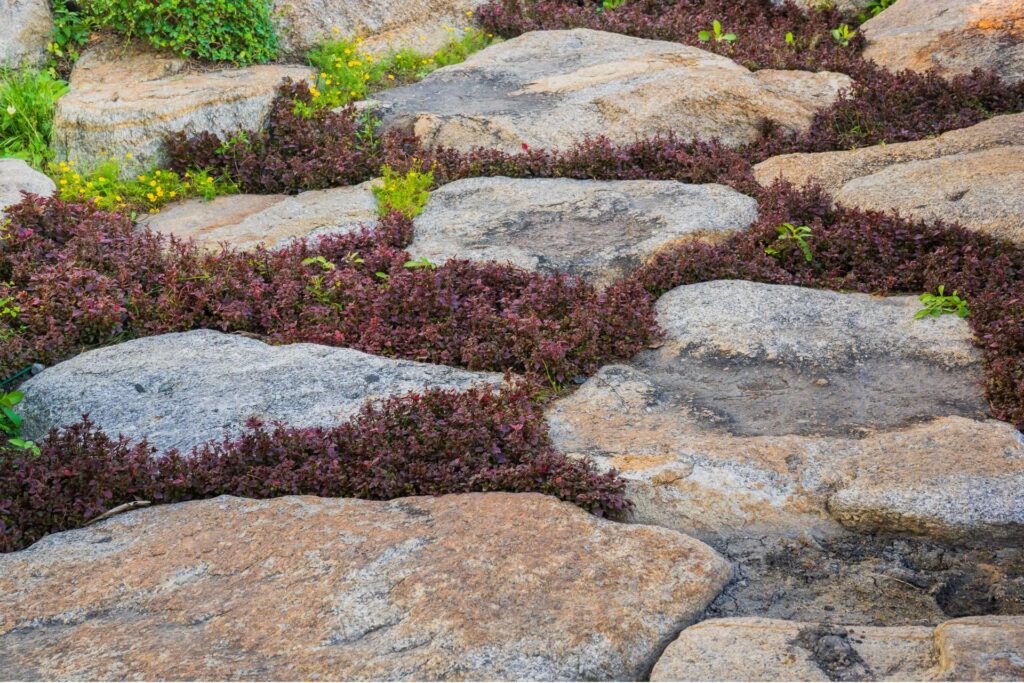
Utilize local rocks to create nooks and microhabitats for drought-tolerant plants in rock gardens, enhancing both aesthetics and plant survival.
What plant characteristics help them survive Wellington’s coastal conditions?
Plants with flexible stems or specialized leaf coatings are better adapted to withstand strong winds and salt spray typical of Wellington’s coast.
How should I arrange plants for effective shelter and erosion control?
Layered planting works best: tall trees at the back, dense shrubs in the middle, and low groundcovers in front. This arrangement filters wind and stabilizes soil effectively.
Are there plants that tolerate both water inundation and drought?
Yes, many plants thriving in Wellington’s coastal areas are adapted to withstand periods of both water inundation and drought, making them ideal for variable coastal conditions.
Which native New Zealand plants are best suited to Wellington’s coast?
Native plants such as Pōhutukawa, Griselinia littoralis, Karo, and Taupata form dense, salt-resistant barriers and provide year-round structure with minimal maintenance.
What is divaricating growth and why is it important?
Divaricating growth is a plant form with interwoven branches and small leaves, which protects against high winds and moisture loss, common among New Zealand coastal species.
What materials withstand Wellington’s coastal environment for landscaping?
Use durable materials like hardwoods or metal alloys resistant to salt corrosion and high-velocity gales. Marine-grade stainless steel fixings are recommended for longevity.
How should mulch be applied in coastal gardens?
Mulch heavily with inorganic materials such as gravel, pebbles, or seashells to prevent it from blowing away, as bark mulch is less effective in windy coastal conditions.
How can soil quality be improved on sandy coastal sites?
Incorporate generous amounts of compost and organic matter to enhance water retention and fertility in sandy, nutrient-poor soils typical of coastal Wellington.
What types of decorative stones are suitable for coastal landscaping?
Coastal Landscape Supplies offers a range of aggregates including pebbles, boulders, crushed shell, white pumice, red scoria, and lime chip, each providing aesthetic and functional benefits for pathways, garden beds, and driveways.
How can crushed shell benefit my garden?
Crushed shell is not only visually appealing but also effective in keeping snails away from plants, making it a practical choice for coastal gardens.
What landscaping services are available in Wellington?
Companies like Carlton Landscapes specialize in gardening and landscaping services in the Wellington region, offering comprehensive project management from design through to build.
Can professional landscaping increase my property value?
Yes, professional landscaping can increase property values by 10-30% in Wellington, making it a worthwhile investment.
Are sustainable landscaping practices common in Wellington?
Increasingly, Wellington landscaping companies adopt sustainable and innovative practices, often working with local nurseries to source high-quality, climate-suited plants for coastal gardens.
Conclusion
Coastal landscaping in Wellington NZ presents unique challenges due to its exposure to strong winds, salt spray, steep terrain, and sandy soils. However, with thoughtful landscape design, the right plant selection, and durable materials, it is possible to create stunning, functional outdoor spaces that thrive in these conditions. By incorporating native and hardy plants, layering shelter belts, and using quality construction methods, homeowners can enjoy year-round usability and spectacular views while protecting their investment.
Whether you live on the Kapiti Coast, in the Hutt Valley, or anywhere along Wellington’s diverse coastline, understanding local microclimates and working with experienced teams ensures your gardening and landscaping not only survives but flourishes. Coastal landscaping is a long-term commitment that rewards patience with a beautiful, sustainable environment that complements the natural surroundings and enhances your lifestyle.
Investing in professional coastal landscaping transforms challenging sites into extraordinary outdoor living areas, increasing property value and providing lasting enjoyment. Embrace the unique beauty of Wellington’s coast by creating a resilient garden designed to withstand the elements and captivate for years to come.